


Single-component adhesive designed for bonding dry and wet wood, wooden elements, window frames, staircases, as well as for bonding wood with foam polystyrene, mineral and glass wool, PUR foam, cardboard.
EUH 066 Repeated exposure may cause skin dryness or cracking.
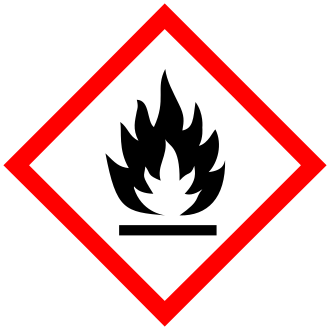
H225 Flammable liquid and vapors.
H319 Causes severe eye irritation.
H336 May cause drowsiness or dizziness.
P101 If medical advice is needed, have product container or label at hand.
P102 Keep out of reach of children.
P103 Read the label before use.
P241 Use [electrical equipment/ventilation equipment/lighting equipment/…] that is explosion-proof.
P303 + P361 + P353 IN CASE OF CONTACT WITH SKIN (or hair): Immediately remove all contaminated clothing. Rinse skin with water [or shower].
P305 + P351 + P338 IN CASE OF CONTACT WITH EYES: Rinse cautiously with water for several minutes. Remove contact lenses, if present and easy to do. Continue rinsing.
P405 Keep locked up.
P501 Dispose of contents/container in accordance with regulations.
a strong anion exchange resin with fine particle size, suitable for conservative restoration. Anionic resin is used for the desulphating chemical cleaning treatment of carbonate stone surfaces (marbles, stones, ...), plasters and frescoes.
A thermoplastic resin based on polyvinyl acetate homopolymers used for the production of paints, varnishes, sizes, etc. Soluble in alcohols, esters, ketones, toluene and chlorinated hydrocarbons, and is particularly suitable for the consolidation and heat-sizing of archaeological finds and ceramics.
The name “elemi” is in the ordinary way practically restricted to the somewhat soft aromatic oleo resinous body
collected in the Philippine Islands from one or more species of Canarium, principally Canarium luzonicum
Gum Arabic is a dried exudate obtained from the stems and branches of Acacia senegal (L.) Willdenow or closely related species of Acacia (fam. Leguminosae). It is used as an emulsifier, stabilizer, and thickener. One gram dissolves in 2 ml of water forming a solution which flows readily and is acid to litmus, insoluble in ethanol .