

Naziv vsebine

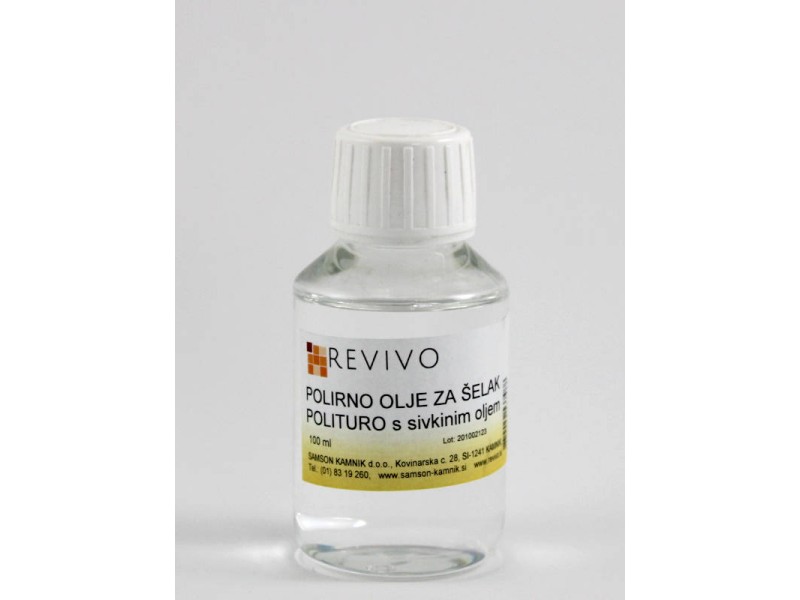
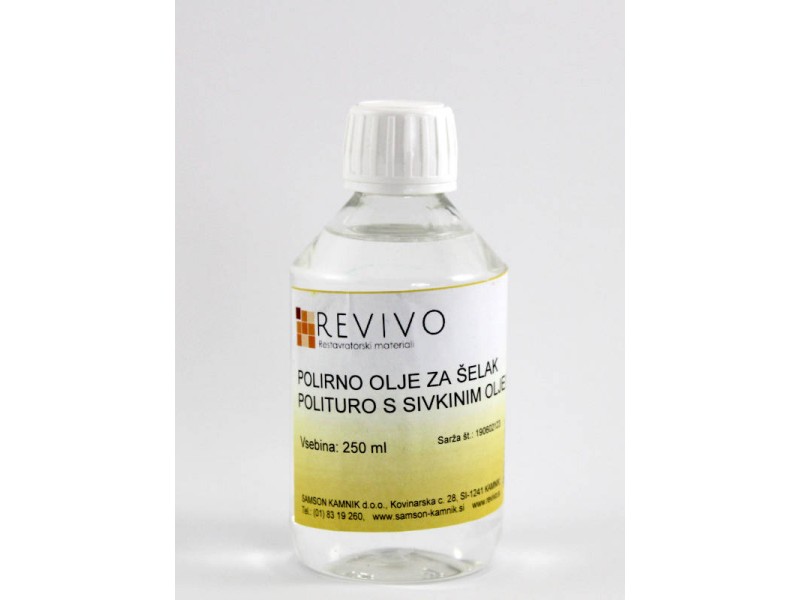
POLISHING OIL 100 ml or 250 ml

| 100 ml |  Date of delivery not known Date of delivery not known | 6,10 € | ADD TO CART | ||
| 250 ml |  Date of delivery not known Date of delivery not known | 12,20 € | ADD TO CART |
SHELLAC
HISTORY and EXTRACTION
With the development of new trade routes to the Far East in the 17th century, shellac also appeared in Europe.
It is a resin of animal origin, secreted by scale insects (Kerria Lacca, Collus Lacca, Tacharrdia Lacca Kerr, and several other Tacharrdia insects), which feed on the resin of various tree species such as Croton lacciferum, Euphorbiaceae, Ficus religiosa, Artocarpus, and some species of Butea, primarily in Eastern India, Sri Lanka, and the Antilles.
Raw shellac is collected on tree branches as a 3-8 mm thick crust, which contains numerous female scale insects. The locals collect it, crush it, and wash it with water. This removes wood fibers, sugars, water-soluble salts, and the red dye lac dye. Shellac is then heated, filtered through fabric, and the resulting melted mass is manually stretched into thin layers. Once cooled, it is manually or mechanically crushed into flakes of various sizes or ground into powder.
VARIETIES OF SHELLAC
Filtered and ground shellac contains up to 5% wax. Depending on the type of wood and its geographical location, shellac varies in color. The most characteristic representatives are:
- lemon (yellowish color)
- orange (orange-brown color)
- ruby (reddish-brown color)
For polishes with a particularly high gloss, the following are used:
- decolorized shellac without wax (almost colorless or slightly yellowish in thin layers)
- shellac gold
- shellac orange without wax
PREPARATION OF SHELLAC
To prepare the polish, shellac is dissolved in ethanol or a combination of alcohols (e.g., Shellac solvent – Samson Kamnik d.o.o.). For the highest quality polishes, various other natural resins are also added to the shellac solution, such as mastic (resin from Pistacia lentiscus from Chios, Greece), copal (fossil resin from Zaire or resin from living trees Trachylobium, Hymenaea courbaril from Zanzibar, Mozambique, Australia).
The usual concentration of shellac in the solvent is 12-20%. The solution is left to stand overnight, then filtered. This prepared polish can only be stored for a few months, as the drying times of the polish are prolonged due to hydrolysis.
POLISHING
Making quality polish requires quite a bit of skill and experience.
The process can be summarized in the following phases:
A/ Priming - rubbing in diluted polish
B/ Filling pores
C/ Covering polish
D/ Smoothing: - polishing
- re-polishing
Before polishing, the surface is sanded with sandpaper 600 or 800 or steel wool 000. The most important tool for polishing is the pad. It is made from cotton or wool, wrapped in a linen cloth. For priming and filling pores, coarse linen cloth is used, while finer cloth is used for covering polish and smoothing. The pads are stored in a well-sealed glass container.
Priming:
The pad is soaked in a strongly diluted polish, which is poured into a shallow container, and it is rubbed into the surface of the wood with longitudinal and transverse movements. Let it dry thoroughly overnight.
Filling pores:
You can use the pad with which you primed. Now use undiluted polish, applying or adding ground pumice under the pad. Pumice is a volcanic rock with a microporous structure and is used as a mild abrasive.
Wood dust created during sanding, pumice powder, and dissolved shellac form a filling mixture that must be rubbed into the wood pores with the pad.
Be careful not to add too much pumice, as the pores will turn gray.
Dry for at least 1 hour.
Then sand the surface with fine sandpaper.
Covering polish:
Form a firm pad, soak it in undiluted polish, and with longitudinal and transverse applications, first with stronger pressure, then with lighter pressure. Change the pad 1 to 2 times. Be careful not to drag the pad over the still wet surface or tear the already formed polish film. To assist, use a few drops of polishing oil to moisten the polishing pad from underneath. If the underside of the pad begins to shine, it is a sign that the cloth is clogged. This cloth must be washed with alcohol. With the last pad, polish until it is completely dry. This brings the residues of polishing oil to the surface. Dry for at least 2-3 hours.
Lightly sand again with fine sandpaper 600-800 or pumice powder.
Smoothing-polishing:
Use a pad with a fine linen cloth in combination with shellac polish with a few drops of polishing oil. With the polishing pad, make quick, circular movements.
Let it dry overnight. Then sand only the poorly or less well-treated areas with pumice powder.
Let it dry for 2-3 days if possible.
Smoothing-repolishing:
Prepare a fresh pad with the finest linen cloth. Use strongly diluted polish and a few drops of polishing oil and polish with gentle, circular movements. Finally, add only alcohol to "extract" the last residues of polishing oil. Change the linen cloth several times so that the residues of oil do not again cloud the surface.
The polish is dry after at least 60 hours.
Even though shellac polish is properly executed, the surface is relatively sensitive to water, heat, and solvents.
Nevertheless, shellac polish has a special aesthetic effect and still represents a high level of craftsmanship in the treatment of wooden surfaces.
Related products
